
The Agent Layer Is Rewriting Software
Why 2026 may be the year domain-specific AI tools stop looking like chatbots and start looking like infrastructure

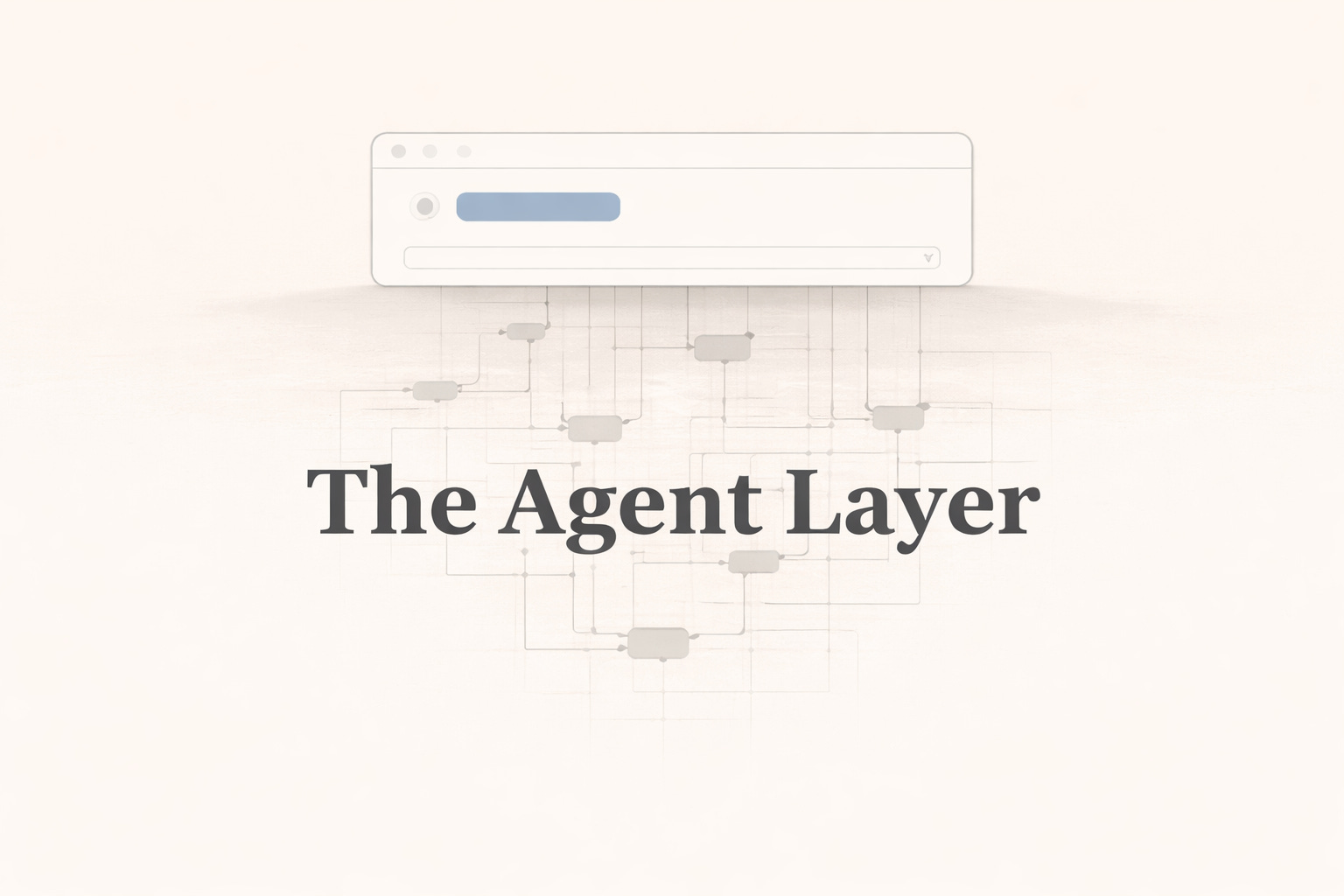
For the last three years, most people have experienced AI through a chat window. That made powerful models accessible, but it also made the shift look smaller than it really is. The chat window was only the first surface. What is emerging now is an agent layer: software that can interpret intent, gather context, call tools, move across systems, and execute bounded work. OpenAI now describes its Responses API as a unified interface for building agent-like applications with built-in tools such as web search, file search, computer use, code interpreter, and remote MCP servers. Anthropic’s Model Context Protocol, or MCP, points in the same direction. Models are being connected to real data sources and real systems through a standard interface.[1][2]
Once you see that, a clearer conclusion follows. The real story is no longer that AI can answer questions. The story is that AI is being wired into workflows. The shift is from assistance beside the work to action inside the work. AI is moving into the tools, documents, and systems of record people already use. We are moving from asking for help to delegating bounded parts of a workflow under constraints. The center of gravity is shifting from response to execution. [1]
This is why agents matter. Not because autonomy is new in the abstract, but because the surrounding architecture is getting real: permissions, context, tool use, feedback loops, and checkpoints. Anthropic’s guidance on production agents is revealing here. Their argument is not that everyone should build sprawling autonomous systems. It is almost the opposite. Start simple. Use composable patterns. Add agentic behavior when the task genuinely benefits from it. That is a much more useful frame than the hype cycle. It treats agents not as magic, but as a practical systems design problem. [3]
OpenClaw makes this shift especially visible. It presents itself, very plainly, as “the AI that actually does things,” handling tasks like clearing an inbox, sending emails, managing calendars, and checking in for flights from chat apps people already use. That matters because it suggests a different way of organizing software. The chat interface is not the product. It is the control surface. The product is the system behind it: the tools, permissions, memory, routing, and execution logic that let the agent carry work forward. [4]
That is a meaningful break from how software has worked for decades. Traditionally, software was something you opened and navigated. You moved from app to app, screen to screen, menu to menu. In an agentic stack, software increasingly becomes something that can be invoked, chained, and audited. The question shifts from “How do I use this app?” to “What actions can a trustworthy agent perform on my behalf?” OpenAI’s tooling model and MCP both reinforce this direction. Capabilities are being exposed as callable functions behind an intelligent layer rather than only as interfaces a person clicks through manually. This is the space where the interaction design and ambient computing innovations of this era will come from - AI ambient interfaces. [1][2]
On the professional side, this gets even more interesting, because the winners will not be generic agents floating above work. They will be domain-shaped systems that absorb the grammar of a field. Legal work needs document awareness, review paths, and defensible outputs. Harvey says more than 100,000 lawyers across 1,000-plus organizations in 60 countries rely on its platform. Healthcare needs reliability, compliance, source visibility, and integration into systems clinicians already use. Abridge positions its product around clinical documentation and workflows integrated directly inside Epic, with auditable “Linked Evidence” that ties AI summaries back to the source conversation. These are not just chatbots with better branding. They are software products being rebuilt around the actual structure of the work. [5][6]
Construction and design software shows the same pattern. Autodesk describes Autodesk Assistant as an agentic AI partner appearing across tools like AutoCAD, Revit, Fusion, and Autodesk Construction Cloud, with context-aware assistance, data validation, summarization, and increasingly workflow-level actions. Procore has gone a step further and explicitly introduced “Agentic APIs,” arguing that conventional transactional APIs were not built for the heavy lift of AI and that construction workflows now need endpoints designed for retrieval, verifiable answers, and agentic workflows. That is what a platform looks like when it starts reorganizing around agents instead of static screens alone. [7][8]
We have seen versions of this shift before. Excel did not just make accounting faster. They changed what accountants could do. CAD did not just digitize drafting. It redefined how architects and engineers iterated, tested, and collaborated. Excel and AutoCAD became part of the medium of the work itself. That is the closest analogy for what is happening now. Agentic systems are not just speeding up existing workflows. In the strongest cases, they are starting to reshape the structure of those workflows from the inside. The software still exists, but its center of gravity is moving.
This is also why 2026 feels different from the first consumer wave of AI. The early phase was novelty, conversation, and surface productivity. This phase looks much more like workflow infrastructure. The useful question is no longer “Which model is smartest in a vacuum?” It is “Where can intelligence be embedded so that work gets done more reliably, more legibly, and with less interface friction?” That is a much harder question, but also a more consequential one.
That is why the biggest story of 2026 is unlikely to be a single model launch or benchmark jump. It is that software is being reorganized around agents - agent orchestration. Consumer software becomes more delegated and conversational. Professional software becomes more domain-specific, auditable, and execution-oriented. The chat interface remains, but increasingly as an entry point. The real product lives behind it: tools, skills, permissions, memory, workflow logic, and the domain knowledge needed to make action trustworthy.
If this trend holds, 2026 will not be remembered as the year AI replaced software. It will be remembered as the year software started to be restructured from within by systems that can reason, retrieve, route, and act. Once that shift becomes visible, the question is no longer whether AI will be part of software. The question is what software looks like when intelligence is not just answering, but operating.
References
[1] OpenAI, *Migrate to the Responses API*. https://developers.openai.com/api/docs/guides/migrate-to-responses
[2] Anthropic, *Introducing the Model Context Protocol*. https://www.anthropic.com/news/model-context-protocol
[3] Anthropic, *Building Effective Agents* (December 19, 2024). https://www.anthropic.com/engineering/building-effective-agents
[4] OpenClaw, *Personal AI Assistant*. https://openclaw.ai/
[5] Harvey, *Built for High Stakes Work*. https://www.harvey.ai/customers
[6] Abridge, *Generative AI for Clinical Conversations*. https://www.abridge.com/
[7] Autodesk, *Autodesk Assistant: Your agentic AI partner*. https://www.autodesk.com/solutions/autodesk-ai/autodesk-assistant
[8] Procore, *Building the Foundation for AI in Construction: The Next Era of the Procore Marketplace & APIs* (March 2, 2026). https://www.procore.com/blog/building-the-foundation-for-ai-in-construction-the-next-era-of-the-procore